
What does endometriosis really mean?
This past Christmas season, my mom, who is post-menopausal, started hemorrhaging and experiencing abnormal uterine bleeding (AUB). For those familiar with this, you know that any bleeding after menopause is an immediate red flag and a sign for your gynecologist to investigate for uterine or cervical cancer.
This went on for at least a week—she was going through every super tampon and pad available. She lost so much blood that she became dizzy, lightheaded, weak, and was sleeping all day. This was especially concerning since she has been anemic for the last 15 years or so. Specifically, she has very low ferritin (iron storage). Both low iron and this new hemorrhaging had her on the couch all holiday break.
Another issue with low iron stores is reduced clotting ability, which is why many women—both young and older—experience heavy periods that don’t seem to have an “off” switch.
After visiting the gynecologist, an ultrasound was performed. She was diagnosed with adenomyosis and endometriosis. Her endometrial lining was thickening, and her uterine size was equivalent to a 9-week gestation. On top of that, fibroids and cysts were present. One visit turned into a complex and overwhelming diagnosis.
The gynecologist’s biggest concern was the continued heavy bleeding. They feared that if this did not stop, this could life threatening. They told her the only option was a full hysterectomy to stop the hemorrhaging and prevent the anemia from progressing further.
After working with several women post-hysterectomy, I knew this was not a road we wanted to go down.
So we immediately got to work.
First, we focused on increasing blood flow to the area. This may sound counterintuitive, but it’s actually central to many reproductive health issues. Endometriosis and adenomyosis are often associated with blood stasis, impaired circulation, inflammation, and mineral deficiencies.
This is where we brought in yarrow root—known for its ability to reduce bleeding, calm inflammation, and support proper blood flow, both to the uterus and systemically. Within a day of consistent use, her bleeding reduced significantly.
Here’s the catch—when she stopped taking it, the bleeding returned. Not with a vengeance, but it did come back. This showed us that while yarrow was helping her circulation, there was still a deeper root cause driving the inflammation.
What was causing the blood stasis, low energy, and inflammation? That’s what we set out to uncover.
While she continued on yarrow and red root tinctures (a powerful combination often used in traditional practices for reproductive inflammation), we completed a GI stool test. We prioritized this for several reasons.
First, her ferritin levels were extremely low. For someone who eats a significant amount of local, grass-fed red meat, this didn’t make sense. Something was interfering with iron absorption—or potentially “stealing” it.
Second, her thyroid antibody markers had recently indicated autoimmunity. In many cases, elevated thyroid antibodies can be associated with underlying infections.
Sure enough, her stool test revealed multiple pathogenic red flags.
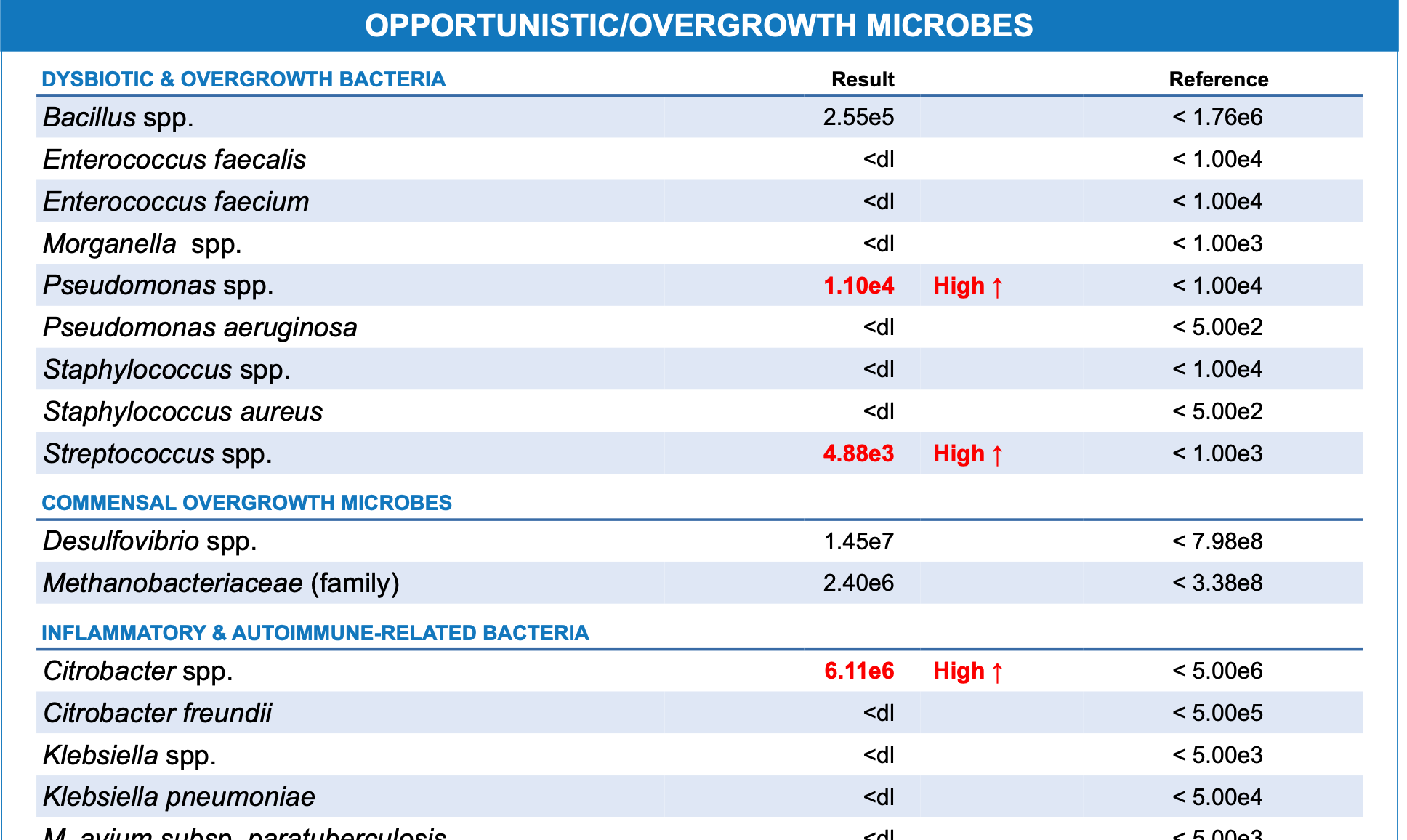
Pseudomonas spp., Streptococcus spp., Citrobacter spp. - all highly inflammatory harmful bacteria likely contributors.
This is where the bigger picture began to unfold.
These pathogens were primarily gram-negative bacteria that produce lipopolysaccharide (LPS) endotoxins—highly inflammatory compounds released into the body. You can think of these bacteria as constantly releasing inflammatory toxins internally. They are also known to be histamine producers.
And this is where things get even more important.
Endometriosis and adenomyosis are often linked to estrogen imbalance—typically excess estrogen. However, many women (including my mom) have low total estrogen levels.
This is where the system often fails women.
Her gynecologist saw low estrogen on bloodwork—which is expected in post-menopause. But low circulating estrogen does not mean there isn’t excess estrogen being improperly metabolized and cleared from the body. In other words, when estrogen is not being detoxed properly or down harmful pathways, this estrogen can proliferate and grow in the form of fibroids, cysts, polyps, or endometrial lining.
Her DUTCH hormone panel confirmed that her estrogen metabolism was impaired. Estrogen was not being properly detoxed and excreted.
So even though her blood levels appeared low, functionally, estrogen was still contributing to dysfunction.
And what does excess estrogen do? It drives histamine levels in the body higher.
Now combine that with histamine-producing gut pathogens, and you have a vicious cycle:
Gut pathogens increase histamine
Histamine increases inflammation
Estrogen dysregulation worsens
Elevated estrogen further increases histamine
It becomes a loop that’s difficult to break and often leaves women wondering what came first.
Additionally, several digestive markers came back suboptimal—especially pancreatic function and fat digestion.

These are foundational steps in digestion. When they’re impaired, nutrient absorption suffers, and the body becomes more vulnerable to pathogens.
On top of that, her gut showed significant inflammation.
So we continued with yarrow and red root, while also:
Adding targeted digestive enzymes
Supporting fat metabolism
Incorporating anti-inflammatory support
Strengthening gut defense
Supporting drainage pathways, especially liver function
For women dealing with reproductive issues—endometriosis, adenomyosis, PCOS, cysts, fibroids, polyps, PMS, or irregular cycles—this is always part of the bigger picture.
In my practice, we consistently address the liver, kidneys, gallbladder, and bile flow. Because it’s incredibly rare to see optimal liver function and healthy bile flow in women struggling with these conditions.
The liver processes everything—including hormones. When it becomes congested, the reproductive system often takes the hit.
So when you’re dealing with cycle irregularities, pain, abnormal bleeding, or tissue growth like fibroids or cysts, you have to ask: where is the upstream dysfunction? What process is blocked that should be flowing?
These conditions are systemic. They’re not isolated to the reproductive organs.
Often, key systems have become overburdened—not broken, but in need of support.
They are asking for:
Mineral balance
Liver support
Proper bile flow
A healthy, non-inflamed gut
Nervous system regulation
Without addressing these, it’s very difficult to create lasting change.
At this point in my life, many of my friends, colleagues, and even family members are dealing with endometriosis or severe reproductive health challenges. And as you may know, endometriosis and PCOS are the leading causes of infertility—something more common now than ever before.
The conventional approach often focuses on symptom management—medication, temporary relief, or short-term outcomes. But what happens long-term?
Procedures like a hysterectomy, once reserved for later in life, are now being recommended to women in their 20s and 30s—forcing early surgical menopause and eliminating the possibility of future fertility.
We have to ask: how did we get here?
For example, in endometriosis, the endometrial tissue continues to thicken and spread when the root cause isn’t addressed. This growth can extend beyond the uterus—even reaching other organs.
I’m currently working with someone whose endometrial tissue has spread as far as her liver.
And the options offered? Pain medication, hysterectomy, D&Cs, or endometrial ablation. Of course, this may be an option you choose to go with. You do you! But know that cutting out vital organs or scraping out very much alive tissue is NOT your only option.
These are serious, often painful interventions that don’t address the underlying drivers of tissue growth, inflammation, or systemic dysfunction.
They don’t resolve:
Tissue proliferation
Low ferritin
Gut and digestive dysfunction
Chronic fatigue
The real, long-lasting solution? Rebuilding the system from the ground up—mineral by mineral, restoring gut health, and supporting the body’s natural detox and drainage pathways.
So here is the takeaway - for those struggling with endometriosis, severe heavy bleeding leading to anemia, or other menstrual or reproductive health issues like these, start thinking deeper. In the meantime, use herbs like Yarrow Root, Red Root, Motherwort, etc. to help support congested reproductive lymph, reduce inflammation, and support circulation. This has been a life saver in my practice for those facing the “urgent” recommendation of a hysterectomy no matter the age. Then, test don’t guess. Get to the bottom of your symptoms.
You can book a free consultation on my page so I can learn more about you and your health struggles, and get a better sense of how I can help you ditch your symptoms for good!
